

Over the next few weeks we're walking with one church in the book of Acts. It’s not because they were perfect or had it all together. God simply holds them up as a kind of measuring stick for us. The church at Antioch shows what happens when the gospel is allowed to shape both what we believe and how we actually live with each other.
Last week we saw a church born out of the Word, built by the Word, and branded by the Word. Sound doctrine is necessary for the church. It isn't just for theology geeks. It’s absolutely essential for every believer, for real growth and life. But truth on its own isn't enough. It has to be lived out together in real life.
That means truth has to be both pursued and it needs to be able to be discovered. Can somebody actually say out loud here, "I'm in a bad place right now"? Or do they figure out pretty quickly that they're supposed to just smile and say they’re "fine"? When the questions get hard or the mess gets too messy, do we lean in with gentleness, or do we step back so the mess doesn't get on us? Is this is a safe place for honest questions and true transparency, or do people have to hide? There is no pursuit of true truth if people have to hide their questions.
In Acts 11:27–30 we see Antioch get advance notice of a coming famine. They don’t panic. They aren’t in denial about what’s going on. They don’t freeze. What we see them do is a model for us about not just how we handle benevolence ministry, but how we handle people period. They listen to the need and they respond with careful, sacrificial care.
The big idea before us today that Francis Schaeffer put forth as his second content is that a church after God’s own heart feels freedom to “ask honest questions and gives honest answers.”
We must be honest about needs before needs can ever be met. (11:27–28)
Luke begins this section by telling us that “prophets came down from Jerusalem to Antioch.” The Word of God is moving between churches. God isn’t isolating His people. He is preparing them. One of those prophets we see is named Agabus. Verse 28 tells us that he “stood up and foretold by the Spirit that there would be a great famine over all the world (this took place in the days of Claudius).”
God is preparing His people for something that is coming. And notice how Antioch receives this word. They don’t treat it as speculation. They don’t dismiss it as alarmism. They take it seriously. They receive it. Francis Schaeffer insisted that the church must learn to live in this kind of posture. He wrote,
“The second content is that Christianity is truth, and we must give honest answers to honest questions. Christianity is truth, truth that God has told us, and if it is truth it can answer questions.”[1]
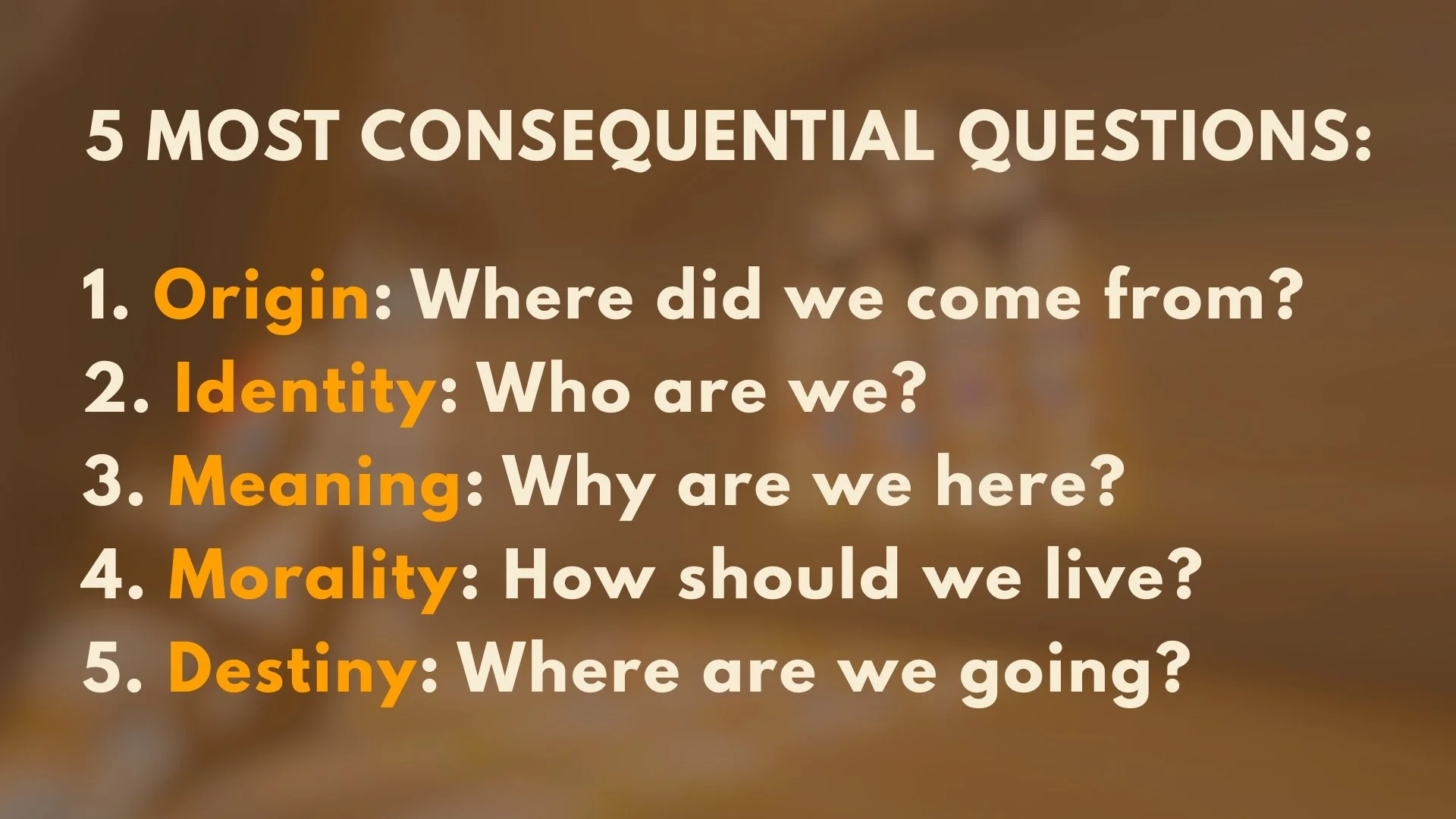
Every person/worldview seeks to answer these questions.
Since Christianity is true truth, it can answer people’s deepest needs. In Antioch, their “question” wasn’t only intellectual. It was deeply practical. How will God’s people respond when hardship and suffering arrives? But we need to see something else. This passage isn’t only about food. It’s about honesty. The church is told that need is coming. And that announcement creates a space for preparation to meet the need. Vulnerability is brought into the open. This meets us where we are.
We live in a culture that is starving. Not just economically. Spiritually. Biblically. Relationally. People are hungry for meaning. Hungry for truth. Hungry for someone who will take their questions seriously. There is a famine in the land, and it is a famine of the Word of God. I read this passage just this week and I couldn’t shake it.
Amos 8:11 – “Behold, the days are coming,” declares the Lord God, “when I will send a famine on the land—not a famine of bread, nor a thirst for water, but of hearing the words of the Lord.”
Many people have never learned how to read Scripture. Others have learned just enough to feel ashamed of their questions. So you know what they do? They hide their doubts and questions. They mask their struggles and act like everything’s ok. And the church can unintentionally become a place where people feel they have to perform instead of being open and honest.
But God doesn’t meet us in the version of ourselves we pretend to be. He knows who we are. And He meets us as we truly are. If Antioch had ignored Agabus, there would have been no preparation. If the church pretends there is no need, there can be no care. Schaeffer saw this clearly. He wrote,
“Christianity demands that we have enough compassion to learn the questions of our generation. The trouble with too many of us is that we want to be able to answer these questions instantly, as though we could take a funnel put it in one ear and pour in the facts and then go out and regurgitate them and win all the discussions. It cannot be. Answering questions is hard work. Can you answer all the questions? No, but you must try. Begin to listen with compassion, ask what this man’s questions really are and try to answer. And if you don’t know the answer try to go some place or read and study to find some answers.”[2]
At L’Abri, this became a lived culture. People came with doubts, fears, anger, confusion, all of it. And they weren’t dismissed. They were welcomed. Over meals, over long conversations, questions were taken seriously because people were taken seriously. And people flocked there from all over. And after all these decades, branches of L’Abri still exist all over the world. I once participated in a lunch discussion at L’Abri in Southborough, outside Boston. A question was raised, and for the rest of that meal, everyone around the table wrestled with it. No one was shamed. No one was silenced. The idea was examined. The person was respected. That kind of atmosphere said something powerful. God takes people seriously. So should we.
A church that wants to meet real needs must first be honest about them. We should meet physical needs. We should help one another. And when we need help, we should make that known so that we can receive the care God intends to give us through others. BUT we must also be honest about the deeper famine. The hunger for truth. The confusion about Scripture. The questions we don’t ask anyone.
The Word of God is the bread of life. And so many are starving. Even in this church. We need to help people eat. Sometimes that means patiently spoon-feeding for a while. And sometimes that means being humble enough to say, “I don’t understand this. Can someone help me?”
A grace-formed church bears the burdens of others. (11:29)
Verse 29 tells us what Antioch does with what they have heard. “The disciples determined, every one according to his ability, to send relief to the brothers living in Judea.” First, notice who acts. “The disciples.” Not a board. Not a wealthy benefactor. Not an intellectual elite. The whole church responds. This isn’t a fundraiser where people are pressured to give. It’s a family decision that flows from the grace they have received from God. They all play a part in meeting the needs of the time.
Second, notice how they act. “Every one according to his ability.” There is no uniform demand of “you must do it this way.” There’s no comparison. Each person responds as they are able. They are functioning as the Body of Christ is intended to.[3]
Third, notice where they act. “To send relief to the brothers living in Judea.” To Jewish believers. Y’all, Antioch is a largely Gentile church. These people are helping those who, not long ago, many Jews would not have even eaten with them. The grace of God is crossing cultural lines. The gospel is breaking down old walls. Schaeffer insisted that the church’s love must be visible if it is to be credible. He wrote,
“If we do not show beauty in the way we treat each other, then in the eyes of the world and in the eyes of our own children, we are destroying the truth we proclaim … Men should see in the church a bold alternative to the way modern men treat people as animals and machines today. There should be something so different that they will listen something so different it will commend the Gospel to them.
Every group ought to be like that, and our relationships between our groups ought to be like that. Have they been? The answer all too often is no. We have something to ask the Lord to forgive us for. Evangelicals, we who are true Bible-believing Christians, must ask God to forgive us for ugliness with which we have often treated each other when we are in different camps.
I am talking now about beauty and I have chosen this word with care. I could call it love, but we have so demoted the word that it is often meaningless. So I use the word beauty. There should be beauty, observable beauty, for the world to see in the way all true Christians treat each other.”[4]
We must bear each other’s burdens. That means we need to create a culture where people can say, “I’m not okay,” and not be avoided like the plague. It means we patiently walk with people through seasons of doubt without being scared of their doubts. (After all, Spurgeon said doubt is a foot poised to go forwards or backwards in faith).[5] Bearing each other’s burdens means making room for questions. It means letting people be weak. Not everyone has to be strong all the time. If we only create space for strength, we will never become a place where people can heal. Antioch shows us that grace forms a people who move toward need, not away from it.
Care is delivered through people who can be trusted. (11:30)
Verse 30 adds one more detail that adds weight to this. “They sent it to the elders by the hand of Barnabas and Saul.” This shows us that the care is carried by people who are trusted, whose lives are already visible, whose character is already proven, whose faithfulness is established. There is stewardship and accountability there.
This is what Schaeffer called “form and freedom.” Actually the whole essay this two contents and two realities is based on is titled “Form and Freedom in the Church.”[6] There is real generosity, but it’s not careless. Freedom is held inside faithfulness. God gives leaders to guard the good deposit of faith.[7] In Antioch, the church gives to meet the coming need, Barnabas and Saul carry it, and the elders receive it. Everyone knows where the gift is going. Everyone knows who is responsible.
That’s what builds trust. Trust is essential for a culture of honesty. People won’t be honest about their real needs if they don’t believe those needs will be handled well. They won’t ask real questions if they don’t trust the answers to be coming from a place of real concern. They won’t confess their struggles if they expect to get shame instead of honest care.
When a church pairs doctrinal clarity with honest care, it becomes a living answer to the world’s hardest questions. (Acts 11:19–30)
Last week’s text and this week’s text are meant to be read together. In Acts 11:19–26, Antioch is formed by the Word. For a whole year, Barnabas and Saul teach “a great many people.” Doctrine shapes them. They are rooted in the true truth of God’s Word. And it shapes how they live and what they pursue. In Acts 11:27–30, that same church hears about famine—a real need—and responds to meet that need. The Word that formed them now flows through them. Truth and care don’t rival each other. Right doctrine births right practice. Orthodoxy determines orthopraxy.
What would it look like for our church to treat the famine of our time as seriously as Antioch treated theirs? What would it look like to become a place where questions are welcomed? Where doubts are discussed? Where struggles are named? Where Scripture is opened patiently, again and again, without looking down on people?
What would it look like for people to say, “That is a place where I can bring my whole self. My fears. My failures. My confusion. My hunger.” Schaeffer believed that this wasn’t optional. He wrote,
“Every church, every mission, every Christian group… should be a pilot plant that the world can look at and see there a beauty of human relationships which stands in exact contrast to the way modern men treat people… There should be something so different that they will listen, something so different it will commend the Gospel to them.”[8]
Amen! Antioch was that kind of place. Truth was taught. Need was named AND need was met. So Christ was made visible.
That’s how it must be here. By God’s grace, that’s how it will be here. If you are a skeptic, or a struggler, or a quiet doubter, hear this. You are invited to bring real questions. You are welcome to seek real answers. You are not a threat. You are a person God takes seriously. Because He wants to lead you to the Truth. Himself.
A church after God’s own heart is a place of truth and care. It is not a place of performance. It listens to needs. And it answers with thoughtful, sacrificial, accountable love. May God make us that kind of church.
[1] Schaeffer, 371
[2] Schaeffer, 372
[3] Romans 12:4 – “For just as the body is one and has many members, and all the members of the body, though many, are one body, so it is with Christ.”
[4] Schaeffer, 375–76
[5] https://jdgreear.com/are-you-willing-to-doubt-your-doubts
[6] https://lausanne.org/content/form-and-freedom-in-the-church
[7] 2 Timothy 1:14
[8] Schaeffer, 375
